Every brass idol that leaves our Khatauli workshop carries within it a secret that is 5,000 years old. The lost-wax casting process—known in French as cire perdue—is the ancient technique our craftsmen use to breathe life into molten metal, transforming it into sacred forms of deities worshipped across India and the world.
What Is Lost-Wax Casting?
Lost-wax casting is one of humanity's oldest metalworking techniques, with origins stretching back to the Indus Valley Civilisation around 3000 BCE. Archaeological excavations have unearthed exquisite bronze figurines—like the famous "Dancing Girl" of Mohenjo-daro—crafted using this very method. Ancient Egypt, Mesopotamia, Greece, and China all developed sophisticated lost-wax traditions independently, testament to the technique's universal appeal and effectiveness.
In India, this craft has been passed down through generations of artisan families, particularly in traditional metalworking hubs like Khatauli in Uttar Pradesh. What makes lost-wax casting so enduring is its ability to capture extraordinary detail while producing strong, durable castings that can last centuries.
Step 1 — Creating the Wax Model
Every brass idol begins as a vision in the hands of a master sculptor. Using pure beeswax—softened slightly by warming—the artisan meticulously sculpts the deity by hand. This wax model is not a rough approximation; it must capture every intricate detail: the serene curve of Lord Ganesha's trunk, the delicate fingers of Goddess Lakshmi in abhaya mudra, the ornate jewelry adorning Radha-Krishna.
This stage requires years of training. The wax must be warm enough to work but not so soft that details blur. Every fold of a dhoti, every strand of a sacred thread, every petal of a lotus throne is carved with precision. The wax model is the idol in its first incarnation—perfect, complete, and destined to be sacrificed.
Step 2 — Building the Clay Mould
Once the wax sculpture is complete, it is coated in a specially prepared clay mixture. This clay is not ordinary—it combines fine riverbed clay with cow dung (which adds organic fibers for strength), sand (for heat resistance), and rice husk (which burns away to create porosity, allowing gases to escape during casting).
The first coat is gossamer-thin, painted on with a soft brush to capture every microscopic detail. Subsequent coats are thicker, building up a robust shell that can withstand the intense heat and pressure of molten brass. Between each layer, the mould is dried carefully in the shade—never in direct sunlight, which could cause cracking.
This process takes several days. By the end, the wax model is completely encased in a thick clay cocoon, with only a small opening at the top through which the wax will escape and the brass will later enter.
Step 3 — The "Lost Wax" Moment — Firing the Mould
Now comes the transformative step that gives the technique its name. The clay-encased mould is placed upside-down in a furnace and gradually heated. As temperatures rise, the beeswax inside begins to melt. It liquefies, flows downward through the opening, and drips out—taking with it every trace of the original sculpture.
The wax is quite literally lost, leaving behind a perfect hollow cavity inside the hardened clay shell. The furnace continues to fire, baking the clay mould rock-hard and burning away any residual wax or organic materials. What remains is a negative space—an absence in the exact shape of the idol yet to be born.
Step 4 — Pouring Molten Brass
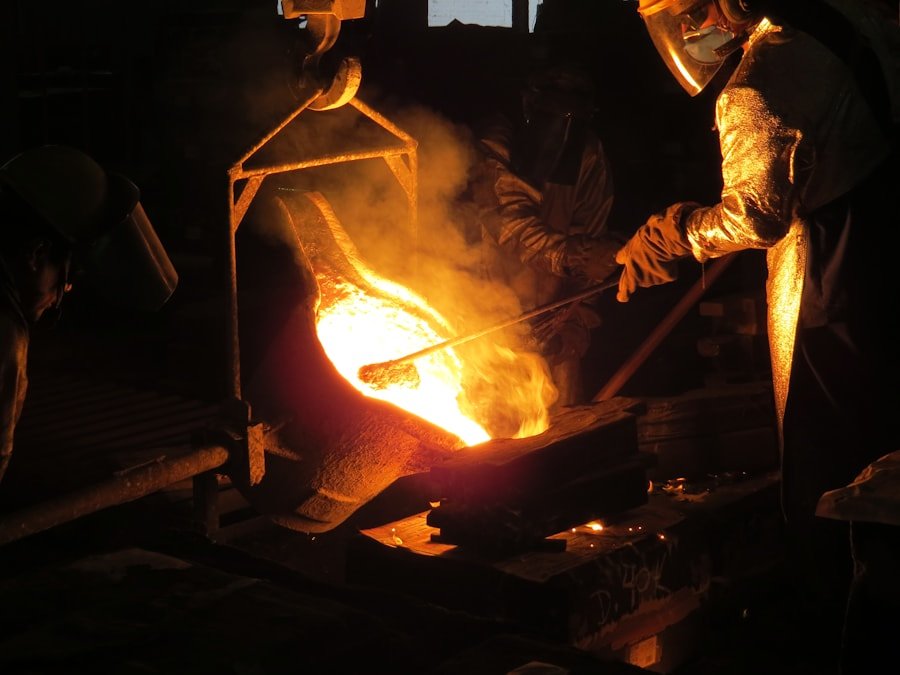
In the foundry, brass ingots are melted in a crucible furnace. At Deshna Wholesale, we use a traditional brass alloy: approximately 70% copper and 30% zinc, melted at temperatures exceeding 900°C until it glows bright orange and flows like honey.
The Brass Alloy Used at Deshna Wholesale
Our brass composition is carefully calibrated. Too much copper makes the metal too soft; too much zinc makes it brittle. The 70-30 ratio—refined over centuries—produces brass that is strong, workable, and develops a beautiful golden patina over time. For more on this, see the science of brass alloy.
The molten brass is poured in a single, continuous stream into the mould through the same opening the wax once drained from. The metal fills every void, every hairline detail of the cavity. Then comes the hardest part: waiting. The casting must cool slowly, naturally, over several hours or even overnight. Rushing this stage risks cracks and internal stresses.
Step 5 — Breaking the Mould and Finishing
Once cooled, the clay mould is carefully broken away with hammers and chisels. Piece by piece, the shell falls away to reveal the raw brass casting inside—a rough-edged, oxidized version of the deity, but recognizably the same form first sculpted in wax.
What follows is weeks of finishing work: filing away the casting channels, chiselling to refine details, sanding, and polishing until the brass glows. Master artisans re-carve facial features, deepen folds in garments, and burnish surfaces to a mirror finish. This is where artistry meets metallurgy.
Why Lost-Wax Produces Superior Idols
Compared to sand casting or machine casting, lost-wax offers unmatched advantages. Sand moulds are reusable but cannot capture fine detail. Machine-cast idols are identical and soulless. Lost-wax produces one-of-a-kind pieces with crisp detail, internal strength (no air pockets), and the subtle variations that mark true handcraft.
Each idol is unique because each wax model is unique. The mould is destroyed in the process, ensuring that no two castings are ever identical. This is why collectors prize browse our handcrafted brass idols—each is an original.
Preserving This Ancient Craft at Khatauli
At Deshna Wholesale, we are committed to keeping this 5,000-year-old technique alive in the modern world. Our craftsmen in Khatauli still mix clay by hand, still sculpt wax under flickering lamps, still judge the readiness of molten brass by its color rather than thermometers.
Yet we also embrace modern quality standards: controlled furnace temperatures, calibrated alloys, safe working conditions. This fusion of ancient wisdom and contemporary excellence is what sets Deshna Wholesale apart. Learn more about our full manufacturing process or about Deshna Wholesale.
Lost-wax casting is not just a manufacturing method—it is a spiritual practice, a meditation in metal. When you bring home an Deshna Wholesale brass idol, you are not simply purchasing a decorative object. You are becoming a custodian of an ancient tradition, a keeper of craftsmanship that has survived millennia.
Ready to explore these masterpieces? Discover our collection of handcrafted brass idols made using the time-honored lost-wax technique. Each piece is a testament to the skill, patience, and devotion of our Khatauli artisans. For more on our heritage, read The Ancient Art of Brass Idol Making.