Every year, millions of Plaster of Paris Ganesha idols are immersed in India's rivers, lakes and seas during Ganesh Chaturthi — leaving behind a toxic legacy of non-dissolving chemical residue, heavy metal paints and destroyed aquatic ecosystems. There is a better way.
The Hidden Environmental Cost of Plaster of Paris Idols
Plaster of Paris, the material used in over 80% of Ganesha idols sold for Chaturthi celebrations, does not dissolve in water like traditional clay. Instead, PoP idols take decades to break down, sitting at the bottom of water bodies and releasing toxic substances. The chemical paints used to decorate these idols contain lead, mercury, cadmium and other heavy metals that leach into the water, poisoning aquatic life.
Studies by the Central Pollution Control Board (CPCB) have documented mass die-offs of fish and the destruction of aquatic ecosystems in the days following large-scale idol immersions. India's rivers — already under stress from industrial pollution and sewage — receive an additional toxic load every Ganesh Chaturthi. Coastal areas fare no better, with beaches littered with idol fragments and marine life impacted by the sudden chemical influx.
The scale of the problem is staggering. In Mumbai alone, over 150,000 Ganesha idols are immersed annually. Multiply that across Maharashtra, Karnataka, Andhra Pradesh, Tamil Nadu and other states celebrating the festival, and you have an environmental crisis that recurs every single year.
The Traditional Alternative — Clay Idols
Before the industrial era, Ganesha idols were made from natural unbleached clay known as shadu mati. These clay idols dissolve quickly in water, returning to earth without leaving toxic residue. Traditional clay idols are painted with natural pigments that pose no threat to aquatic life.
Some artisans still craft authentic clay Ganeshas, keeping the pre-industrial tradition alive. However, these idols are more expensive than mass-produced PoP versions and considerably more fragile. Many families have switched to PoP simply because of cost and convenience — not realizing the environmental price.
The Modern Eco-Friendly Alternative — A Permanent Brass Ganesha
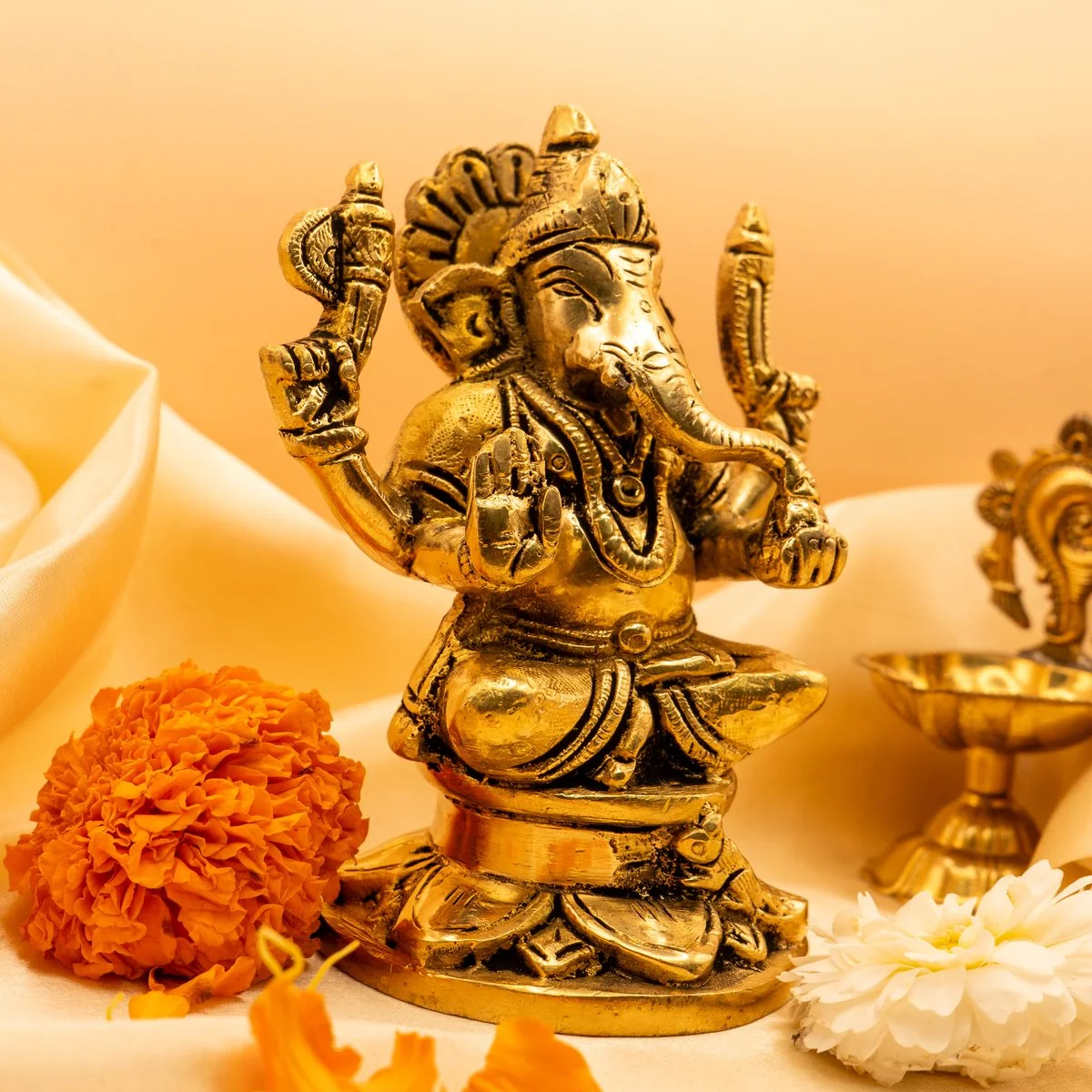
Brass offers a solution that honors tradition while eliminating annual waste. A brass Ganesha is a natural, non-toxic metal alloy that requires no water immersion. One brass Ganesha idol can be used for decades or even passed down through generations, creating zero annual waste.
The economic argument is compelling: while a brass idol costs more upfront than a PoP version, it eliminates the need to purchase a new idol every year. Over a decade, the brass option is far more cost-effective. But the spiritual argument may be even stronger — a consecrated brass Ganesha that is worshipped year after year accumulates puja energy, becoming more sacred over time rather than being discarded annually.
The Growing Movement Toward Permanent Festival Idols
Courts in Maharashtra and other states have issued orders restricting the use of PoP idols and mandating designated immersion sites to reduce environmental damage. A growing eco-conscious middle class is questioning the logic of buying and discarding a new idol every year. This has sparked a trend toward permanent brass and copper festival idols that are worshipped and kept, not immersed.
The shift mirrors a broader movement in India toward sustainable religious practices — from biodegradable flower offerings to eliminating single-use plastics at temples and festivals.
How to Celebrate Ganesh Chaturthi with a Brass Idol
Celebrating Ganesh Chaturthi with a brass idol is simple and spiritually fulfilling:
- Install your brass Ganesha on a beautifully decorated platform (maach) on Ganesh Chaturthi day
- Perform the full 10-day puja with fresh flowers, modak offerings, daily arati and bhajans
- On Anant Chaturdashi (immersion day), perform a symbolic visarjan ceremony using a small clay murti or flower in water instead of the brass idol
- Keep the brass Ganesha on your home altar year-round, performing daily or weekly puja
Many families report that this approach deepens their connection with Ganesha, as they build a relationship with the same murti over years rather than treating it as disposable.
What to Look for in a Brass Ganesha for Chaturthi
When selecting a brass Ganesha for festival celebrations, consider these factors:
Pose: The sitting Siddhi Vinayaka pose is considered most auspicious for Chaturthi celebrations, representing accomplishment and removal of obstacles.
Trunk direction: Right-trunk Ganeshas (Siddhi Vinayaka) are rarer and represent more active, powerful energy. Left-trunk versions are more common and embody calmer, gentler energy. Both are appropriate for Chaturthi.
Size: For a 10-day festival setup with visibility for arati and darshan, a 9-12 inch brass Ganesha is ideal. Learn more about Vastu placement for Ganesha.
Finish: Gold-finish brass creates the most festive atmosphere, though natural brass and antique finishes are equally sacred.
The Bigger Picture — Brass as a Sustainable Choice
Brass is a recyclable metal that can be melted down and recast without quality loss, though a well-maintained brass Ganesha will never need recycling. Unlike PoP, brass involves no annual disposal, no toxic chemicals and no environmental harm. It's a natural material whose production supports skilled artisan livelihoods rather than factory mass-production.
Choosing a brass Ganesha over PoP is a vote for both tradition and the environment. It's a statement that our devotion to Ganesha includes devotion to protecting the natural world he embodies. In a country where water is increasingly precious and pollution threatens public health, this choice matters.
This Ganesh Chaturthi, consider bringing home a permanent brass Ganesha. It's an investment in sustainability, tradition and a deeper spiritual practice — one that honors Lord Ganesha without harming his creation. Explore our brass vs resin comparison and discover why brass is the best metal for divine idols.