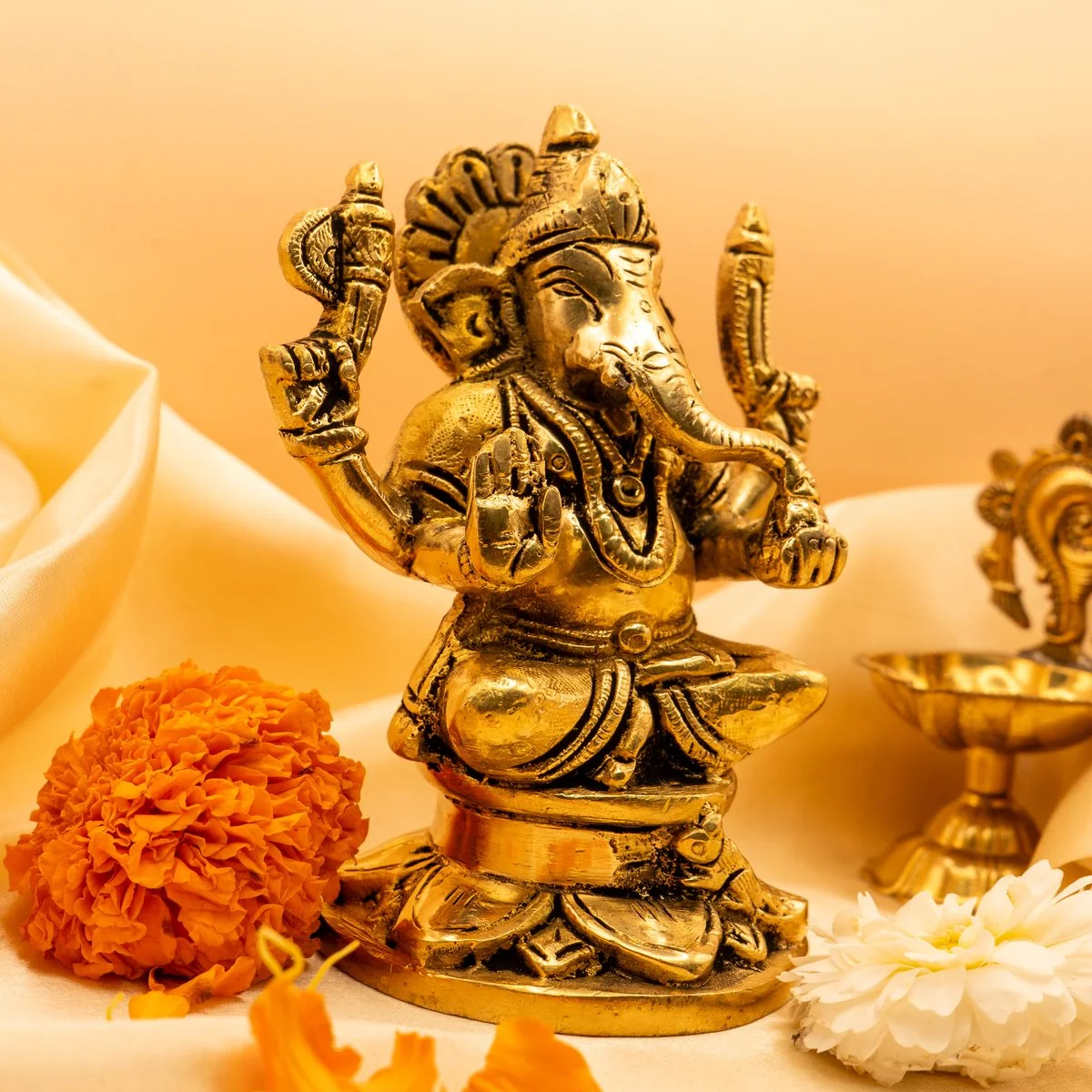
Ganesha is the most beloved deity in Indian homes — the remover of obstacles, the lord of new beginnings. At our Khatauli workshop, making brass Ganesh idols is not just our most practised craft, it is a devotional act performed daily by artisans who have inherited centuries of iconographic knowledge.
Every Ganesh idol that leaves Deshna Wholesale Enterprise has passed through eight pairs of skilled hands, travelled from molten wax to molten brass, and been finished with reverence. This is the complete process.
Capturing Ganesha's Iconography in Wax
Before the first cut is made in wax, our master sculptor reviews the Shilpa Shastra — the ancient Sanskrit texts that prescribe exact proportions for deity forms. A Ganesh idol must capture several precise iconographic elements:
- The elephant head with large ears symbolising wisdom and attentive listening
- Four arms holding specific attributes — modaka (sweet), broken tusk, lotus, and abhaya mudra (blessing gesture)
- The curved trunk — direction matters in Vastu; right-curving trunks are standard for home worship
- The pot belly representing the cosmos contained within
- The mouse vahana (vehicle) at the base — symbolising humility and control over desires
- The broken tusk — from the Mahabharata legend where Ganesha broke his own tusk to continue writing
Getting these details right is non-negotiable. A Ganesh idol is not merely decorative — it is a consecrated form used in daily puja.
Sculpting the Wax Master Model
The artisan begins with a solid block of refined beeswax mixed with resin for workability. Using heated steel tools, he carves the basic form — pot belly first, then the seated posture with one leg folded and one pendant. The trunk direction is decided early: for home puja idols, we sculpt a right-curving trunk, which is considered easier to please in daily worship.
The four arms are positioned next. The upper right hand holds the broken tusk; the upper left cradles a modaka (sweet dumpling). The lower right hand is raised in abhaya mudra (fear-dispelling gesture), while the lower left may rest on the knee or hold a lotus. Each finger, each curve of the palm, each fold of the dhoti is carved with patient precision.
The mouse vahana is sculpted separately — a tiny, detailed form positioned near Ganesha's feet, often holding a modaka in its paws. This small detail alone takes an hour to perfect.
Building the Clay Investment Mould
Ganesha's complex iconography — the trunk, the multiple arms with held objects, the crown, the mouse — creates dozens of undercuts and cavities that complicate mould-making. Our mould-makers apply investment clay in careful layers, ensuring venting channels reach the trunk tip, each finger, the inside of the ears, and the modaka details. Poor venting here means incomplete casting — a missing tusk or malformed trunk would render the idol unsuitable for worship.
The clay-encased wax model is then fired in the kiln. The wax melts away (the lost-wax casting process), leaving a perfect negative cavity ready for molten brass.
The Brass Pour — Critical Moment
For larger Ganesh idols (above 12 inches), we often cast in multiple pieces: the head and trunk as one unit, the body and arms as another, and the mouse vahana separately. These are later joined using traditional bronze welding techniques. This multi-piece approach allows finer detail control and reduces the risk of casting defects in complex areas.
The brass alloy — typically 70% copper, 30% zinc — is heated to 1,050°C. The pour must be swift and steady. Ganesha idols require more metal volume than other deity forms due to the robust proportions, so the furnace is charged accordingly.
Breaking the Mould and First Inspection
After cooling for 24 hours, the clay investment is carefully broken away. The quality inspector examines the raw brass casting for the most common defect areas in Ganesh idols:
- Trunk tip — must be fully formed, not blunted
- Fingers and tusk — sharp detail required
- Crown and ear details — often victims of incomplete fill
- Mouse features — tiny but essential
Only idols that pass this inspection proceed to finishing. Defective castings are returned to the furnace for re-melting.
Finishing the Ganesh Idol
Filing and Chiselling Fine Details
The raw casting bears seam lines, rough patches, and surface imperfections. Our finishers spend two to three days per idol filing these away, then using fine chisels to re-carve details softened during casting: the eyes (often inlaid later), fingernails, jewelry, crown ornamentation, and the folds of the dhoti. The trunk's segmented appearance — suggesting the elephant's natural anatomy — is enhanced with incised lines.
Choosing the Finish — Gold Polish vs Antique
Most Ganesh idols for home puja receive our gold polish finish — a multi-stage buffing and lacquering process that gives the brass a radiant, temple-gold appearance. Some customers prefer an antique or oxidised finish for a more traditional, aged look. The finish is applied after all detailing is complete.
From Workshop to Puja Room
Each completed Ganesh idol is wrapped in protective cloth, packed with cushioning, and dispatched with a quality certificate. Many of our retail partners perform a brief consecration ritual before sale. From our workshop, these idols travel to homes across India and abroad — becoming the centerpiece of daily worship, the first deity invoked before any auspicious event.
We take immense pride in knowing that our brass Ganesh idols are not merely purchased — they are welcomed into families, garlanded, offered prayers, and become witnesses to generations of devotion.
Explore our collection: Browse our Ganesh brass idols or commission a custom Ganesh idol made to your specifications. For guidance on placement, see our guide on where to place your Ganesh idol according to Vastu.