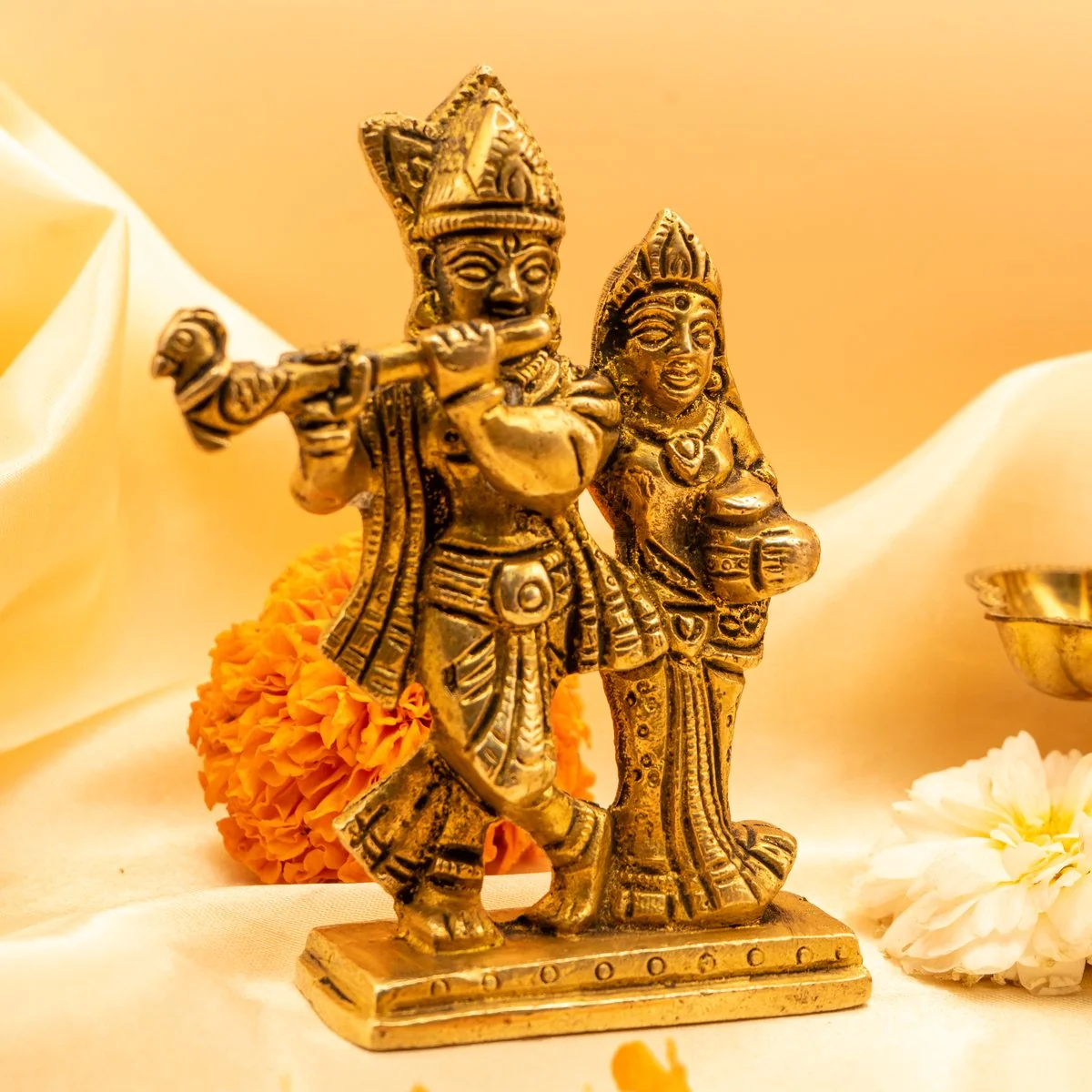
When you stand before a brass deity idol, the hands speak first. Every finger position, every palm angle, every curve of the thumb — these are not aesthetic choices. They are mudras, a precise sacred language encoded into metal by craftsmen who understand that each gesture communicates divine qualities, blessings, and cosmic functions at a single glance.
Understanding mudras transforms how you see a brass idol. What once appeared decorative reveals itself as a sophisticated symbolic vocabulary, carrying millennia of spiritual wisdom in the curl of a finger.
What Is a Mudra and Why Does It Matter in Idol Making?
The word mudra comes from Sanskrit, meaning "seal" or "gesture" — a physical form that seals and transmits spiritual energy. In Hindu iconography, mudras are not improvised. They follow strict codes laid down in ancient texts like the Natyashastra (treatise on performing arts) and the Agamas (temple and ritual texts), which prescribe exact hand positions for each deity.
Traditional brass idol craftsmen train for years to replicate these positions with anatomical precision. A Ganesha's blessing hand must face outward at the correct angle. A Lakshmi's boon-giving palm must tilt downward just so. These are not approximations — they are requirements. The mudra is how the deity's cosmic function becomes visible in form.
The Most Common Mudras in Brass Deity Idols
While there are hundreds of documented mudras across Hindu, Buddhist, and Jain traditions, a handful appear repeatedly in brass deity iconography:
Abhaya Mudra — the gesture of fearlessness and protection. The right hand is raised to shoulder height, palm facing outward, fingers extended upward. This is the "fear not" mudra, assuring devotees of divine protection. You'll see it in Ganesha brass idols, Durga, Vishnu, and Rama.
Varada Mudra — the boon-giving gesture. The hand extends downward, palm facing out, fingers pointing down. This mudra grants wishes and blessings. Lakshmi brass idols nearly always feature this, as do Saraswati and many forms of Vishnu.
Gyan Mudra (Chin Mudra) — the gesture of knowledge and wisdom. The tip of the index finger touches the tip of the thumb, forming a circle, while the other three fingers extend. This mudra appears in Saraswati idols and meditating Shiva forms, symbolizing the union of individual consciousness (index finger) with universal consciousness (thumb).
Dhyana Mudra — the meditation gesture. Both hands rest in the lap, right hand on top of left, palms upward, thumbs touching. This creates a bowl shape representing the vessel of spiritual knowledge. Common in Vishnu's seated forms and Buddha-influenced Shiva representations.
Kataka Mudra — the "holding a flower" gesture. Fingers curve gently as if grasping a delicate lotus stem. You'll recognize this in dancing Nataraja poses and Krishna playing the flute, where the fingers must curve precisely to suggest graceful holding.
Mudras That Signal Specific Attributes
Beyond the foundational five, specialized mudras convey precise divine attributes:
- Tarjani Mudra — the warning gesture, index finger raised
- Pataka Mudra — the flag gesture, all fingers together and extended, signaling announcement or proclamation
- Mushti Mudra — the closed fist, representing power, determination, and controlled energy
- Padma Mudra — lotus hold, fingers spread like petals, seen in Lakshmi and Saraswati
Deity-Specific Mudra Combinations
Most brass deity idols display multiple mudras simultaneously, each hand conveying a different aspect of divine energy:
Ganesha: The classic Siddhi Vinayaka pose shows the right hand in Abhaya (protection) and the left in Varada (blessing). This combination says: "I remove your fear and grant you success." When browsing Ganesha brass idols, check that both gestures are correctly formed.
Lakshmi: Right hand Abhaya, left hand Varada — sometimes called the Shri Mudra combination. Together they create the complete blessing: protection from misfortune (Abhaya) plus the granting of prosperity (Varada). The palm angles matter: Abhaya faces outward, Varada tilts down toward the devotee.
Nataraja: Shiva as the cosmic dancer displays four arms with four distinct mudras: upper right holds the damaru drum (creation), upper left holds agni (fire of destruction), lower right shows Abhaya (fear not), and lower left points to the uplifted foot in Gajahasta (elephant trunk gesture), indicating the path to liberation.
Saraswati: Two hands hold the veena in Kataka mudra (music and arts), one hand displays Varada (granting knowledge), and one shows Abhaya or holds a book or akshamala (prayer beads).
How Mudras Are Carved in Brass — The Craftsman's Precision
Creating a mudra in brass begins at the wax model stage, where the artisan sculpts every finger angle by hand. Small deviations matter: a thumb rotated five degrees too far breaks the mudra. The fingers must separate fully, the palm must face the correct direction, and the proportions must harmonize with the deity's body.
During the lost-wax casting process, the wax model (with its precisely formed mudras) is invested in clay, then melted out, leaving a cavity. Molten brass fills that exact shape. When the mold breaks away, the mudra emerges in metal, finger-perfect.
Finishing work polishes and refines, but cannot change the underlying gesture. This is why the wax stage is so critical — the mudra must be perfect before casting, because after casting it's permanent.
Reading the Mudra Before You Buy a Brass Idol
When evaluating a brass deity idol, the mudra is one of the clearest indicators of craftsmanship quality:
- Are the fingers fully separated, not webbed together by excess metal?
- Is the thumb angle correct for the specific mudra (touching, parallel, or extended)?
- Is the palm direction clearly visible (facing forward, downward, or upward)?
- Is there casting flash (excess metal) obscuring the gesture?
- Are the hands proportionally correct relative to the body size?
Traditional artisans follow the angula sizing system, which ensures that finger length, palm width, and gesture scale harmonize with the deity's overall proportions.
When you browse brass deity idols at Deshna Wholesale, you're seeing mudras executed by craftsmen who learned these gestures from their fathers and grandfathers — unbroken chains of knowledge reaching back centuries. Each mudra is not merely cast; it is transmitted, preserved, and honored in metal.
The next time you see a brass deity's hand raised in blessing, pause. You're not looking at decoration. You're reading a sacred text, written in fingers, sealed in brass, speaking directly to you across time.