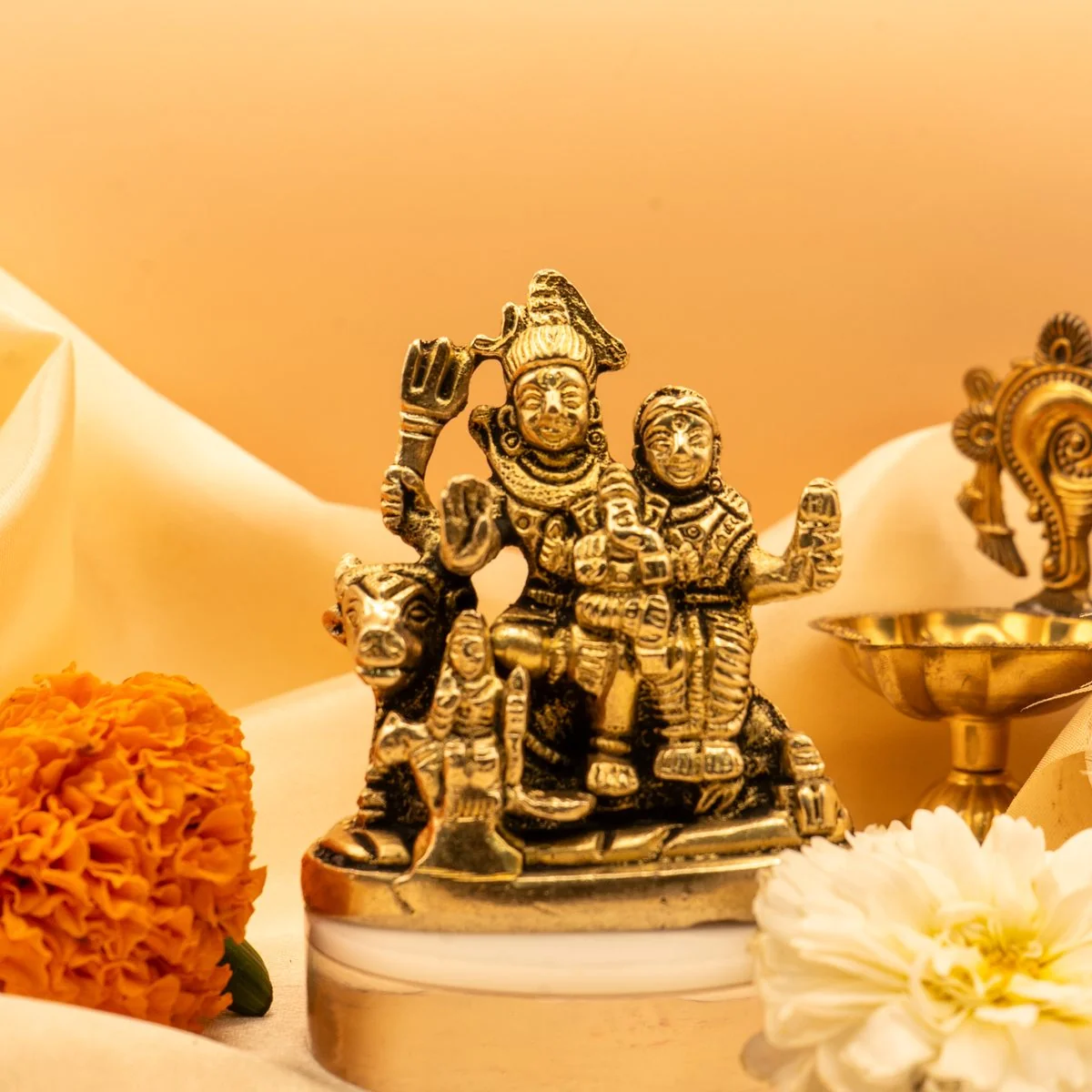
The Trimurti represents one of the most profound concepts in Hindu philosophy — the great cosmic cycle embodied in three divine forms. Brahma the Creator, Vishnu the Preserver, and Shiva the Destroyer come together as a unified expression of the divine, often crafted as a single three-faced idol in brass. This sacred form reminds us that creation, preservation, and dissolution are not separate acts but one continuous dance of cosmic energy flowing through time.
For centuries, artisans have captured this metaphysical unity in brass, creating idols that serve not just as decorative pieces but as powerful tools for contemplation and worship. Each element — from the three faces sharing one body to the symbolic objects held in multiple hands — carries deep meaning that bridges mythology, philosophy, and spiritual practice.
The Three Faces of the Divine — Who Are Brahma, Vishnu, and Shiva?
At the heart of the Trimurti stands Brahma, the Creator, traditionally depicted with four faces representing the four Vedas and the four directions of space. He holds the kamandalu (water pot) symbolising the essence from which creation springs, and a mala (prayer beads) representing time itself. Though Brahma's worship has diminished over millennia, his presence in the Trimurti acknowledges that creation is the foundation of existence.
Next comes Vishnu, the Preserver, who maintains cosmic order and protects dharma. He carries the conch (shankha) symbolising the primordial sound of creation, the discus (chakra) representing the mind and time's cyclical nature, the mace (gada) for mental and physical strength, and the lotus for spiritual liberation. Vishnu's blue complexion in traditional depictions represents infinity, often rendered in brass through antique patina finishes.
Finally, Shiva completes the trinity as the Transformer or Destroyer, whose dance of dissolution makes way for renewal. He holds the trishul (trident) representing creation, preservation and destruction; the damaru (drum) whose beat maintains the rhythm of the universe; and is often shown with the crescent moon in his matted locks and the Ganga flowing from his hair. Together, these three deities form the complete cycle of existence — without beginning or end.
Trimurti Iconography — What Each Element Symbolises
Traditional Trimurti brass idols present all three deities either as three separate figures standing together, or more powerfully, as three faces emerging from a single body. The hands hold the signature implements of each deity — you might see eight, twelve, or even sixteen arms radiating from the central form, each gesture and object carrying layers of meaning. The mudra symbolism in brass idols becomes particularly rich in Trimurti representations.
Many Trimurti idols show the deities seated on a lotus (padmasana), which represents spiritual enlightenment and the unfolding of cosmic consciousness. The brass medium itself holds significance — its golden lustre represents divine light and spiritual radiance, while its durability symbolises the eternal nature of the cosmic cycle. Different brass finishes — from polished gold to deep antique patina — can emphasise different aspects of the iconography.
The Meaning of Three Faces Sharing One Body
When three divine faces emerge from one body, the symbolism becomes unmistakable: these are not three separate gods but three aspects of one supreme reality. This iconographic choice represents the Advaitic principle that all apparent multiplicity springs from singular divine consciousness. The shared torso, the unified energy radiating through multiple arms — all point toward the fundamental unity underlying apparent diversity.
The Philosophical Depth Behind the Trimurti Form
The Trimurti embodies key concepts from Advaita Vedanta, the non-dualistic school of Hindu philosophy. Here, Brahma-Vishnu-Shiva represent not separate entities but modes or functions of one Brahman (ultimate reality). Creation, preservation, and dissolution are revealed as complementary phases of a single eternal process. A wave rises, crests, and falls back into the ocean — are these three different waters, or one water expressing itself three ways?
This understanding transforms worship. When you offer prayers to a Trimurti idol, you're not choosing between deities or hedging your spiritual bets — you're acknowledging that the divine force creating galaxies, sustaining your heartbeat, and eventually dissolving all forms back into pure potential is one continuous presence. The Trimurti teaches that birth and death, beginning and ending, are all sacred movements within eternal being.
This is why some philosophical texts say that worship of any one deity automatically includes the others — a devotee of Shiva unknowingly honours Vishnu and Brahma, because these distinctions exist at the level of name and form, not at the level of ultimate truth.
Regional Variations in Trimurti Brass Idol Designs
South Indian temple traditions tend to produce larger, more ornate Trimurti compositions, often featuring intricate prabhavali (aureoles) behind the deities and elaborate throne designs. The detailing includes fine carving of jewelry, sacred threads, and decorative elements that reflect Dravidian artistic styles. These pieces often serve as centrepieces in established home temples or prayer rooms.
North Indian artisans, particularly from traditional metalworking centres like Khatauli and Moradabad, create more accessible designs suitable for contemporary homes. These Shiva brass idols and Trimurti compositions balance traditional iconography with modern aesthetics — streamlined forms, varied finishes from polished gold to oxidised bronze, and proportions suited to apartment living.
Contemporary designers are also creating minimalist Trimurti representations, sometimes abstracting the three-faced form into geometric patterns or stylised relief work. These modern interpretations maintain the essential symbolism while fitting seamlessly into diverse interior design contexts.
How to Place a Trimurti Idol in Your Home Temple
According to traditional Vastu idol placement guide principles, a Trimurti idol should face east or north, positioned in the northeast, north, or east sections of your prayer room. Because the Trimurti represents all three primary aspects of the divine, it can serve as the central focus of your altar, with other specific deity idols arranged around it if desired.
If you already have individual idols of Shiva, Vishnu, or other deities, the Trimurti doesn't compete — it complements. Some practitioners place the Trimurti in a prominent position to represent the philosophical understanding of unity, while maintaining separate idols for specific devotional practices. The key is to ensure the idol is at eye level or slightly above when you're seated for worship, and that the space around it remains clean and uncluttered.
The prayer room itself should ideally be in the northeast portion of your home, though a dedicated corner in your bedroom or living room can also serve if a separate room isn't available. What matters most is consistent reverence and the intention to create sacred space.
Selecting the Right Trimurti Brass Idol for Your Needs
When choosing a Trimurti idol, first consider your available space. Smaller pieces (4-8 inches) work well for personal altars or study desks, medium sizes (8-14 inches) suit standard home temples, while larger compositions (14+ inches) make powerful statements in dedicated prayer rooms or as living room focal points. You can browse brass deity idols at Deshna Wholesale to see the range of available sizes and styles.
Finish options significantly impact the idol's presence. Polished brass offers golden radiance suitable for vibrant worship spaces, while antique or oxidised finishes provide depth and traditional gravitas. Some idols feature combination finishes — oxidised detailing with polished highlights — creating visual drama that emphasises the iconographic elements.
Consider whether you want a standalone Trimurti composition or a fuller Shiv Parivar grouping that might include Parvati, Ganesha, and Kartikeya alongside the three primary deities. The Trimurti also makes a meaningful gift for housewarmings, weddings, or significant spiritual milestones — it conveys blessings of creation (new beginnings), preservation (sustained prosperity), and transformation (personal growth).
If you have specific requirements — particular size, custom finish, or unique iconographic details — Deshna Wholesale offers custom Trimurti order services, working with skilled artisans to create pieces that perfectly align with your vision and spiritual needs.
Ready to bring the cosmic trinity into your sacred space? Explore our carefully curated collection of Trimurti brass idols and other deity forms. Each piece is crafted with devotion by traditional artisans, carrying forward centuries of spiritual artistry into your home.