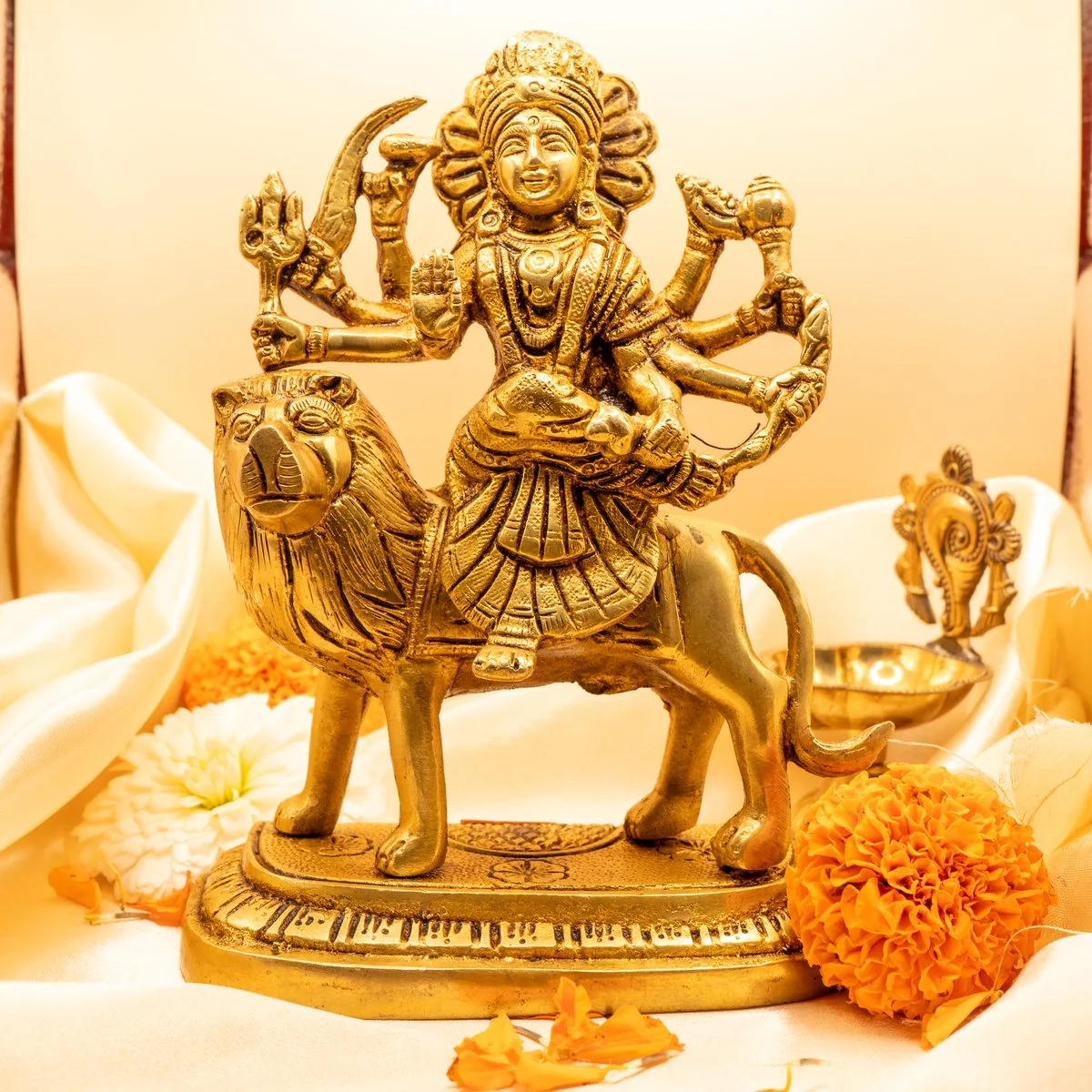
Maa Durga — the invincible mother goddess — embodies Shakti in its most complete form. Every element of her brass idol, from her lion mount to the weapons in her ten arms, carries profound symbolic meaning that devotees have honoured for millennia. When you stand before a finely crafted brass Durga idol, you're witnessing not just artistic excellence, but an intricate visual scripture that encodes the very essence of divine feminine power.
Understanding this symbolism transforms the experience of worship. Each weapon, each gesture, each detail in the brass craftsmanship speaks to timeless truths about courage, protection, and the victory of good over evil.
Who Is Maa Durga? The Divine Warrior Goddess
Durga emerged from the combined energies of all the gods when the demon Mahishasura terrorized the heavens and earth. No single deity could defeat him, so Brahma, Vishnu, Shiva and all the gods channeled their Shakti — their divine power — to create the supreme warrior goddess. Her very name, Durga, means "fortress" or "the unconquerable one."
She appears in multiple forms across Hindu tradition: as Mahishasuramardini (the slayer of Mahishasura), as the nine manifestations of Navadurga worshipped during Navratri, and as Chandika, the fierce protector. From Bengal to Gujarat, from Tamil Nadu to Kashmir, Durga is universally revered as the mother who rushes to her children's defense, wielding divine weapons against all forces of darkness.
Decoding Durga's Iconography in Brass Idol Form
The traditional Durga idol is a masterpiece of symbolic visual language. Master brass artisans spend years perfecting the ability to capture these sacred elements in metal.
The Lion Mount: Durga rides a lion (sometimes depicted as a tiger), representing raw power, will, and fearless determination. The lion is kingship and sovereignty — Durga's command over the animal realm signifies her mastery over all instinctive forces.
Ten Arms: Unlike most deities with two or four arms, Durga possesses ten, symbolizing her ability to act in all directions simultaneously. This represents omnipotence — divine multi-tasking at cosmic scale. When evil threatens from any quarter, she is ready.
The Sacred Weapons: Each of Durga's ten hands holds a weapon or sacred object gifted by different gods, and each carries layered meaning:
- Trishul (Trident) from Shiva: The power to destroy evil across past, present, and future; the three fundamental qualities (gunas) of nature
- Chakra (Discus) from Vishnu: The wheel of dharma, cosmic order, and righteous law that governs the universe
- Sword from Kali: Sharp intelligence that cuts through ignorance, delusion, and false knowledge
- Bow and Arrow from Vayu and Surya: Concentrated energy and goal-directedness; the ability to strike evil from a distance with precision
- Lotus: Liberation, spiritual purity, and detachment even amidst the chaos of battle
- Conch: The primordial sound of Om; the announcement of divine presence
- Club: Raw strength and the power to crush ego
- Vajra (Thunderbolt) from Indra: Spiritual power and firmness of character
Why Durga Holds a Lotus While Wielding Weapons
This is one of the most profound paradoxes in her iconography: Durga is the compassionate warrior. She wields instruments of destruction in most hands, yet holds the unblemished lotus in another. The lotus blooms in muddy water but remains pristine — similarly, Durga engages in fierce battle to protect dharma, yet remains spiritually untouched by the violence she enacts. She is fierce yet benevolent, a warrior yet a mother, destructive yet nurturing.
Master brass craftsmen at Deshna Wholesale pay special attention to rendering this delicate balance — the serene face amid the dynamic action pose.
Mahishasuramardini — The Most Iconic Durga Pose in Brass
The most common brass Durga idol depicts her as Mahishasuramardini — the moment she defeats the buffalo demon. She stands victoriously upon her lion, one foot often placed on the demon, her trident piercing Mahishasura as he emerges from the buffalo's body in his true form.
This is an extraordinarily challenging composition for brass artisans. The pose is dynamic — full of movement and energy — yet must be captured in static metal. Balancing ten arms, each holding different implements, while maintaining graceful proportion and ensuring structural stability, requires generations of inherited skill. The finest brass Durga idols achieve a sense of frozen motion, as if the goddess has been captured mid-battle, her power palpable in every curve and angle of the brass.
Navratri and Durga Puja — When Brass Idols Come to Life
During Navratri, the nine-night festival celebrating Durga's victory over Mahishasura, brass Durga idols take center stage in homes and temples. Families set up elaborate home altars, decorating brass Durga idols with fresh flowers, lighting oil lamps, and offering prayers twice daily.
In Bengal and Assam, Durga Puja is the year's most important festival. While large clay idols dominate community pandals, households maintain permanent brass Durga murtis for daily worship. These brass idols are family heirlooms, passed down through generations, accumulating the spiritual energy of decades of devotion.
This is why families invest in quality brass for festival worship — a well-crafted brass Durga becomes a conduit for divine presence year after year, festival after festival. The tradition of gifting brass Durga idols during Navratri represents passing on protection, blessing the recipient's home with the goddess's watchful presence.
Choosing and Placing a Brass Durga Idol at Home
If you're considering inviting Maa Durga's presence into your home through a brass idol, here are traditional guidelines:
Size: For a personal altar or shelf, a 6 to 8-inch brass Durga is appropriate. For a dedicated mandir room or temple space, 12-inch or larger brass sculptures command the presence the goddess deserves.
Direction: According to Vastu Shastra, Durga idols should face east or north. The worship area itself should be in the northeast corner of your home when possible. For detailed guidance, see our Vastu placement guide.
Room Placement: The puja room is ideal. If unavailable, a clean, dedicated space in the living room works well. Avoid bedrooms or bathrooms.
Daily Worship: Light a ghee lamp or diya before the idol each morning and evening. Offer fresh flowers, incense, and a simple prayer. On Tuesdays and Fridays — days especially sacred to the goddess — enhance your offering with sweets or fruits.
Installation: The most auspicious days for installing a Durga idol are Tuesdays, Fridays, or any day during Navratri — especially Ashtami or Navami (eighth or ninth day). Some families invite a priest to perform a pranpratishtha ceremony, ritually invoking the goddess's presence into the brass form.
Each hand gesture and mudra in brass idols carries meaning — understanding these deepens your connection during worship.
The Living Legacy of Brass Durga Craftsmanship
When you bring home a brass Durga idol, you're not just acquiring a decorative object. You're welcoming a sacred presence, participating in a living tradition thousands of years old, and supporting artisan families whose ancestors have been casting these divine forms for generations.
At Deshna Wholesale, our brass Durga idols are handcrafted using traditional lost-wax casting methods, ensuring each piece carries the weight of authenticity and spiritual intention. Whether you seek a small brass Durga for daily worship or a large ceremonial piece for Navratri celebrations, each idol is created to serve as a bridge between the devotee and the divine.
If you have specific requirements — a particular size, pose, or finishing style — we offer custom brass idol commissions where you can work directly with our master craftsmen.
May the fierce compassion of Maa Durga bless your home. Jai Maa Durga!